I spent forty-three years watching people pour money down the drain—literally. I’ve stood in back gardens after a heavy downpour, watching a brand-new, expensive patio turn into a shallow swimming pool because the homeowner thought a bit of pretty stone was all they needed. They buy the most expensive slabs on the market, but they haven’t given a single thought to how paving affects garden drainage, and that’s where the disaster starts. You can buy the finest granite in the world, but if you haven’t planned for where that water is actually going to go once it hits the surface, you aren’t building a garden; you’re just building a dam.
I’m not here to sell you on fancy landscaping trends or expensive additives that don’t do a lick of good. I’m going to tell you what actually matters: the sub-base, the fall of the ground, and the channels you build to move the water away before it settles into your foundations. I’ll give you the straight truth on how to do it right the first time, so you don’t end up calling me in two years because your sub-base has turned to soup.
Table of Contents
Impermeable Surfaces and Water Runoff the Silent Killer
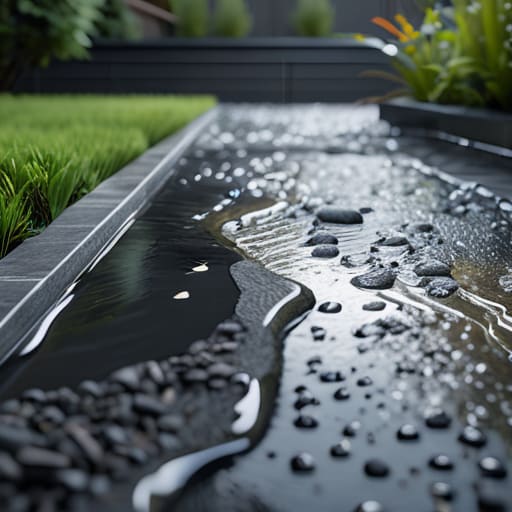
Most people see a nice, clean patio and think they’ve finished the job. They don’t see the disaster they’ve just invited into their garden. When you lay down large, solid slabs with tight mortar joints, you’re essentially creating a lid on a jar. You’ve created impermeable surfaces and water runoff issues that don’t show up on day one, but they’ll show up the first time we get a heavy downpour. Instead of the rain soaking into the earth like it’s supposed to, it hits that slab and has nowhere to go but sideways, gathering speed and volume until it finds the weakest point in your landscape.
If you don’t plan for that movement, you aren’t just landscaping; you’re directing a river straight toward your house foundations or your neighbor’s fence. This is where most lads go wrong—they focus on the look of the stone and completely ignore surface water management in gardens. If you don’t provide a way for that water to escape, you’ll end up with soil saturation from hardscaping that turns your flower beds into a swamp and your lawn into a bog. You can’t just pave over the problem and hope for the best; the water always wins in the end.
Preventing Garden Waterlogging Before the First Pour
If you’re waiting until the concrete is wet to think about where the water is going, you’ve already lost the battle. Most blokes come to me after a heavy downpour when their new patio is sitting in a lake, and I tell them the same thing every time: you don’t solve a drainage problem with a fancy slab; you solve it with the groundwork you did three days prior. Before a single bag of sand is moved, you need to be looking at the natural fall of the land. If your site is a natural bowl, you aren’t just laying paving; you’re building a dam.
To actually succeed at preventing garden waterlogging, you have to stop thinking about the surface and start thinking about the exit strategy. This means digging out enough depth to accommodate a proper sub-base that won’t turn into soup. If you’re dealing with heavy clay, you can’t just dump stone on top and hope for the best. You need to integrate permeable paving solutions or install a soakaway that actually has somewhere to send the excess. If you ignore the sub-surface prep, you aren’t landscaping—you’re just delaying the inevitable flood.
Five Things You’ll Get Wrong if You Only Look at the Surface
- Stop thinking about the slabs and start thinking about the gaps. If you use a fine, sand-filled joint on a large patio, you’ve basically just laid a sheet of plastic over your soil. You need to use permeable jointing compounds or wider, grit-filled gaps so the water actually has an exit strategy.
- Don’t let them talk you into a solid concrete sub-base for a garden area. If you pour a thick, unbroken slab under your paving, you’ve created a dam. Use a granular, compacted sub-base instead—something that lets the water move through the layers rather than sitting on top of them like a puddle in a pothole.
- Watch your falls, and I don’t just mean the slope of the paving. You need to ensure the entire area is graded away from the house and toward a soakaway or a permeable zone. If you’re just sloping it toward a patch of grass that’s already saturated, you’re just moving the problem from one spot to another.
- Check your soakaway capacity before the truck arrives. People love to install fancy permeable paving but then forget they need a place for all that captured water to actually go. If your soakaway is undersized or clogged with silt, your expensive new patio will be sitting in a swamp within two seasons.
- Mind the perimeter. I’ve seen countless jobs where the paving is perfect, but they’ve boxed it in with solid retaining walls or tight borders that leave no room for lateral drainage. You need a clear path for the water to escape the edges of your installation, or it’ll just find its way under your foundations.
Don't Build a Pond, Build a Foundation
Look, I’ve seen it a thousand times: someone spends a fortune on high-end porcelain slabs only to have them sitting in a soup of mud six months later because they treated the ground like an afterthought. You can’t just slap paving over a patch of dirt and hope for the best. If you haven’t sorted your sub-base, calculated your runoff, and ensured the water has somewhere to go that isn’t your neighbor’s basement, you aren’t landscaping—you’re just delaying a disaster. Remember, the drainage isn’t a luxury or a “nice-to-have” extra; it is the entire reason the surface stays level and the soil stays healthy.
At the end of the day, a good job is one where you don’t have to think about it ten years down the line. I don’t care how pretty the stone looks in the brochure; if the water can’t move, the job is a failure. Stop looking at the surface and start looking at what’s happening underneath. Do the hard work now—the digging, the grading, and the proper material selection—and you’ll have a garden that lasts. Build it right the first time, because nature always wins against a shortcut.
Frequently Asked Questions
If I've already laid a solid slab and the water is pooling, can I fix the drainage without ripping the whole thing up?
Look, if you’ve already poured the slab and you’re standing in a puddle, you’ve missed the window where it was easy. You can’t fix the sub-base now. Your options are limited: you either dig a French drain around the perimeter to intercept that runoff, or you install a sump. If the water’s pooling because the slab is sloped the wrong way, you’re stuck. You can try a decorative fix, but gravity doesn’t care about aesthetics.
How much does the type of sub-base material actually change how much water gets through to the soil?
It’s everything. If you think you can just throw some crushed hardcore down and call it a day, you’re asking for a swamp. Using Type 1 MOT is standard for a reason—it packs down tight to give you a solid footing—but it doesn’t breathe. If you want water to actually move through to the soil, you need to be looking at open-graded aggregates. If the sub-base can’t swallow the water, the water stays on top.
I've heard people talk about permeable paving, but is it actually worth the extra cost or is it just a way to charge more for the same job?
Look, I’ve seen enough “cheap” jobs turn into a swamp to know better. Permeable paving isn’t a gimmick; it’s a drainage strategy. You’re paying more for the specialized sub-base and the specific aggregate that allows water to actually move instead of sitting there like a puddle on a slab. If you go with the cheapest option and ignore the runoff, you’ll spend double fixing the subsidence and the rot later. It’s worth it.