I remember standing on a site in ’94, watching a young lad try to explain to a homeowner why their new extension was cracking right down the middle. He was babbling about concrete strength and mix ratios like he’d read it in a textbook, but I could see the truth from ten yards away: they’d poured a perfectly good mix onto a sub-base that was nothing more than uncompacted muck. Everyone wants to talk about the expensive stuff—the reinforcement, the grade of the concrete, the fancy additives—but if you don’t understand how strip foundations work from the ground up, you’re just throwing money into a hole. A strip foundation isn’t just a trench full of wet grey stone; it’s a structural marriage between the building and the earth, and if the earth isn’t ready, the marriage is going to end in a very expensive divorce.
I’m not here to give you a lecture or a list of fancy terms you’ll never use. I’m going to tell you how it actually happens when the boots are on and the mixer is running. We’re going to strip away the nonsense and look at the real mechanics—the soil, the compaction, and the sequence that actually keeps a house level. I’ll show you why the hour before the truck arrives is more important than the pour itself, so you don’t end up calling me to look at a crack ten years down the line.
Table of Contents
Trench Excavation for Foundations It Starts in the Dirt
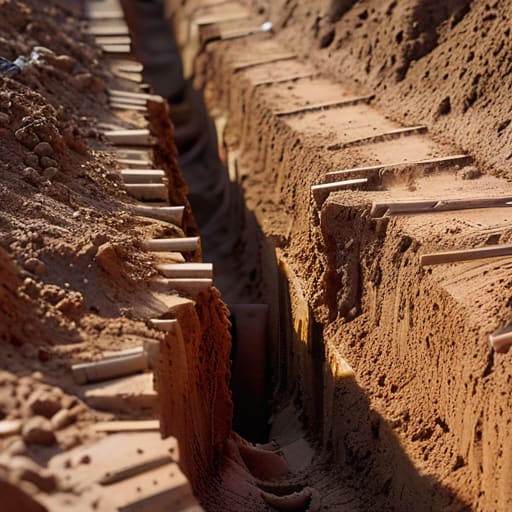
Now, before you even think about calling the mixer, you’ve got to look at the hole you’ve dug. Most lads think trench excavation for foundations is just about moving dirt from A to B until the trench looks right, but that’s where the trouble starts. I’ve seen plenty of sites where they’ve dug a clean-looking trench, only to find they’ve hit a pocket of soft clay or organic muck at the bottom. If you’re sitting your concrete on anything less than solid, undisturbed ground, you’re just building a very expensive way to sink into the earth.
You can have the best mix design in the world, but it won’t do a damn thing if you haven’t respected the soil bearing strength requirements. You need to get down to the true load-bearing strata. If the bottom of that trench is loose, wet, or full of debris, you aren’t building a foundation; you’re building a future crack. I always tell my boys: if the bottom of the trench looks like it’s going to shift under a boot, it’s going to shift under a house. You don’t just pour over bad ground and hope for the best.
Soil Bearing Strength Requirements the Invisible Load Bearing Truth
You can have the best mix design in the world, but if the ground underneath can’t hold the weight, you’re just pouring expensive money into a sinking ship. People get obsessed with the concrete strength, but they completely ignore the soil bearing strength requirements. I’ve seen lads dig a perfect trench, pour a clean footing, and be back within two years because they didn’t realize they were sitting on a layer of soft peat or loose fill. The ground doesn’t care how much cement you put in the mix; it only cares about how much pressure it can take before it gives way.
When we talk about the load bearing capacity of strip foundations, we’re really talking about how that weight gets spread out. If the soil is weak, you can’t just hope for the best. You have to adjust your foundation footing dimensions to spread that load over a wider area, or you’ll end up with uneven sinking. It’s about preventing foundation settlement before the first shovel of aggregate even hits the bottom of the trench. If you don’t respect what’s under your boots, the structure above will eventually tell you about it—usually in the form of cracks that no amount of filler can hide.
The Three Things They Don't Show You in the Manual
- Get your sub-base right or don’t bother pouring; if you’re sitting a foundation on loose, uncompacted rubble or soft topsoil, you aren’t building a house, you’re building a future crack.
- Watch the weather like a hawk because if you pour in a downpour or a heatwave without a plan, the concrete will either wash out or crack before it’s even set.
- Stop the temptation to add water to the truck on-site; I’ve seen too many lads make the mix “slump” just to make spreading it easier, only to watch the strength vanish the moment it dries.
- Plan your joints before the first shovel hits the ground; if you don’t tell the concrete where it’s allowed to move, it’ll decide for itself, and you won’t like the pattern it chooses.
- Respect the curing time and leave the site alone; a foundation isn’t “done” just because it looks hard to the touch—it needs time to gain its strength without being disturbed or dried out too fast.
Don't Waste Your Concrete on a Bad Foundation
At the end of the day, a strip foundation isn’t some magical concrete ribbon that holds a house up; it’s just a way of spreading the load across the ground. If you haven’t dug your trenches to the right depth, if you’ve ignored the actual bearing capacity of the soil, or if you’ve let the sub-base get mucked up with standing water, you’re just building a very expensive way to watch a house sink. You can buy the most expensive, high-spec mix in the country, but it won’t do a lick of good if the ground underneath it is rubbish. Get the excavation right, check your soil, and don’t let anyone talk you into skipping the preparation just to save a few hours on the clock.
I’ve spent forty-three years watching people try to fix structural cracks by slapping more cement on top, and let me tell you, it’s a fool’s errand. You can’t fix a foundation once the weight of the bricks is sitting on it. If you want to do it right, you have to respect the process and respect the dirt. A proper pour is won or lost in the hour before the truck arrives, not when the screed is being finished. Do the hard graft early, get your sub-base solid, and you’ll sleep a lot better knowing that what’s underneath is actually doing its job.
Frequently Asked Questions
How do I know if my sub-base is actually compacted enough, or am I just guessing?
If you’re guessing, you’ve already lost. I’ve seen lads walk over a sub-base, think it feels “solid enough,” and then watch a slab crack six months later because they were just walking on a crust. You don’t guess; you use a compaction tester or a penetrometer. If you can’t afford that, at least use a heavy vibrating plate and check for “spring.” If the ground bounces under your boots, it’s not ready for the concrete.
What happens if I hit unexpected soft spots or clay after I've already started digging the trench?
Stop the machine immediately. If you hit a pocket of soft clay or muck halfway through a trench, you can’t just pour over it and hope for the best—that’s how you end up with a cracked slab in two years. You have to dig it out. You go deeper until you hit something solid, then you backfill that void with compacted hardcore or lean-mix concrete. If you ignore the soft spot, the foundation is already dead.
How much extra concrete should I actually account for if the trench walls aren't perfectly straight?
If you’re planning your order based on a perfect, laser-straight trench, you’re asking for a shortfall. In my experience, you add 10% to 15% to cover the “slop.” If the digger operator’s been a bit heavy-handed or the trench walls are ragged and uneven, that extra volume disappears into those gaps instantly. I’ve seen more jobs grind to a halt because they were short half a cube than because the mix was bad. Always over-order.